How we design · · updated October 2026
The golden ratio, without the legends.
You may have heard that the golden ratio is hidden in the Parthenon, the Mona Lisa and the nautilus shell. It isn’t. The true story is stranger and better than the legend, and it runs from a Greek geometry book to the seeds of a sunflower. It is also the reason every page of this website is laid out the way it is.
I · Where it comes from
A line cut in two
Picture cutting a length of string in two, so that the whole string is to the long piece as the long piece is to the short one. The cut lands a little past six tenths of the way along, and the long piece is about 1.618 times the short one. That number is the golden ratio.
The first person we know for certain to write it down was Euclid, in his geometry book the Elements1, around 300 BC. He didn’t call it golden. He called it cutting a line in “extreme and mean ratio”, and he needed it for a practical reason: you cannot draw a perfect five-sided figure without it. In a regular pentagon, each diagonal is 1.618 times as long as a side, and the five-pointed star inside cuts itself in the same ratio at every crossing.
You will often read that the followers of Pythagoras discovered it and kept the star as their secret sign. That may be true, but the evidence comes from writers who lived centuries later, and historians2 still argue about it.
In 1498 a friar named Luca Pacioli finished a book about it, printed in 1509 as On the Divine Proportion. His friend Leonardo da Vinci drew its pictures of solid shapes, the only book Leonardo ever illustrated. Yet Pacioli advised painters and architects to use simple ratios, not this one. A century later the astronomer Johannes Kepler noticed that 5 is to 8 very nearly as 8 is to 13, and 13 to 21, and wondered if this was how plants grew. He wrote it in a little book about snowflakes that he gave a friend as a New Year’s present.
II · How it got its reputation
Who decided it was beautiful, and when?
For two thousand years this was a useful piece of geometry, a tool like a carpenter’s square. Nobody called it golden, and nobody said it was beautiful.
The word “golden” turns up in a German book as early as 1717, and only became common in the 1800s. Then, in 1854, a German professor named Adolf Zeising measured a great many human bodies and announced that the golden section was a law running through all of nature and art. Almost every claim you have heard about beauty and the golden ratio goes back to him.
In 1876 the scientist Gustav Fechner put it to a test. He laid out ten rectangles and asked people to choose their favorite. The golden one won, but only just: three in four choices were spread across it and its two neighbors. Researchers who have tried since have mostly found the preference weak3. Around 1909 an American engineer, Mark Barr, gave the ratio its Greek letter, φ, after the sculptor Phidias, while saying he doubted Phidias had ever used it.
The famous examples mostly fall apart when someone takes a ruler to them.
The Parthenon’s plans are laid out in simple ratios such as four to nine. When Clement Falbo measured nautilus shells in a museum collection, their spirals widened about three times a turn5; a golden spiral widens almost seven. Leonardo drew his famous man in a circle and a square before he ever met Pacioli. And the Apple logo was drawn, its designer says, from a bowl of real apples.
III · Where it really lives
Sunflowers, crystals and road signs
The places the golden ratio really turns up are less famous, and far more surprising.
Look at the middle of a sunflower. Each new seed grows a fixed turn around from the last, about 137.5 degrees, an angle made from the golden ratio. Because φ is the number that fractions find hardest to pin down, seeds placed at that angle never line up behind one another, and the head packs tight with no gaps. Turn by half a degree more or less and the seeds fall into spokes. Physicists have even made the same pattern with magnetised drops of liquid in a dish, so it seems to be the simple result of things growing one after another, each pushing the last aside.
Nature isn’t tidy about it, though. In 2016 hundreds of volunteers grew sunflowers for a study named after Alan Turing, who had wondered about this before he died. They counted the spirals on 657 heads, and nearly one in five6 broke the famous pattern.
The numbers that go with it, 1, 2, 3, 5, 8, 13, each the sum of the two before, are named after Fibonacci, who wrote about them in 1202. But poets in India had found them centuries earlier, by counting the ways long and short beats can fill a line of verse.
In 1982 the chemist Dan Shechtman saw a crystal whose pattern, everyone agreed, could not exist. Its atoms were spaced in golden proportions. He was laughed at for years, and in 2011 he won the Nobel Prize7. And on any drive, a mile is very nearly 1.618 kilometers. That is pure coincidence, but it means 5 miles is about 8 kilometers, and 8 miles about 13.
IV · Why we build on it
Like a key in music, not a law
We don’t use the golden ratio because it is magic. We use it the way a composer chooses a key: once it’s chosen, every part of the piece belongs to it.
It has two plain properties that make it good at this job. Cut a square from a golden rectangle and what is left is a smaller golden rectangle, and no other rectangle does that, so a page can be divided again and again and every piece keeps the family shape. And on a golden scale, each step is the two steps below it added together. Our type sizes work that way: 16 and 26 make 42, and 26 and 42 make 68.
That matters most on screens, because a screen never holds still. A song in one key sounds like itself on a piano or hummed in the car, and we want a page to look like itself on any screen. The same website is read on a phone in someone’s hand and on a television across the room. Most websites are drawn twice, once as wide as a laptop and once as narrow as a phone, and everything in between is left to stretch until it snaps. We would rather keep one key at every width, so each division of the screen takes the same share of the space it divides, whether the screen is a watch or a wall. A computer checks the rule every time we change the site, so nobody has to remember it and nobody can quietly nudge it out of line.
Book designers have done something like this for centuries, though not usually with this ratio. Many old books are two to three, and the great typographer Jan Tschichold, who studied their pages closely, called the familiar five to eight “no more than an approximation” of the golden section. We like that honesty, and we’ve tried to keep it.
V · What it won’t do
The fine print
Anyone who has signed a contract knows to read the fine print. Choosing a rule means being honest about where it stops, so here is ours.
- 01
It won’t make anything beautiful
A picture that only obeys a rule can feel correct and lifeless, like a song played perfectly in time by someone who isn’t listening. Artists know this better than anyone. The painters we remember learned their rules and then broke them on purpose, because the eye and the feeling come first, and the geometry comes after.
- 02
People don’t reliably prefer it
Fechner’s favorite-rectangle test has been tried many times since 1876, and the preference keeps coming out weak and easily changed by how the question is put. We don’t claim that a golden page pleases anyone more than another.
- 03
Another ratio would be just as consistent
Most of what one proportion gives a page is consistency, and halves or thirds kept faithfully everywhere would give that too. We chose this one for the reasons in section IV: it divides itself, and its steps add up. Those are good reasons, not magic ones.
- 04
A screen can only come close
The golden ratio can’t be written as a fraction, and a screen is made of whole dots of light, called pixels. Our rule rounds every size to a grid of four pixels, so on the page it is always very nearly golden, never exactly. No eye can tell, but we would rather say so.
- 05
Most screens aren’t golden
Phones, watches and tablets almost never have the golden shape. On them we keep the golden point on each dividing line and give up the perfect squares and the perfect spiral. That point is probably the only part a reader ever feels.
- 06
Equal columns are right for equal things
Twelve divides by two, three, four and six, which is why the twelve-column grid that Bootstrap, a popular kit for building websites, made common in 2011 is so handy for rows of products or photographs. We still use equal columns for equal things. Our quarrel is only with drawing a page at two widths and leaving every width between them to chance.
- 07
Our own check didn’t agree with us
We built a rough model of where a first glance lands on a page and ran it over hundreds of our own layouts. The glance found the thing we most wanted found only about one time in five. It is a model, not real eyes, so it proves nothing about people, but it isn’t on our side either.
- 08
Even nature only mostly follows it
One sunflower in five breaks the famous pattern. If a sunflower can be a little off and still be a perfectly good sunflower, a page can be too. We hold the rule firmly, and we hold it humbly.
VI · What we believe
Deciding once is a kindness
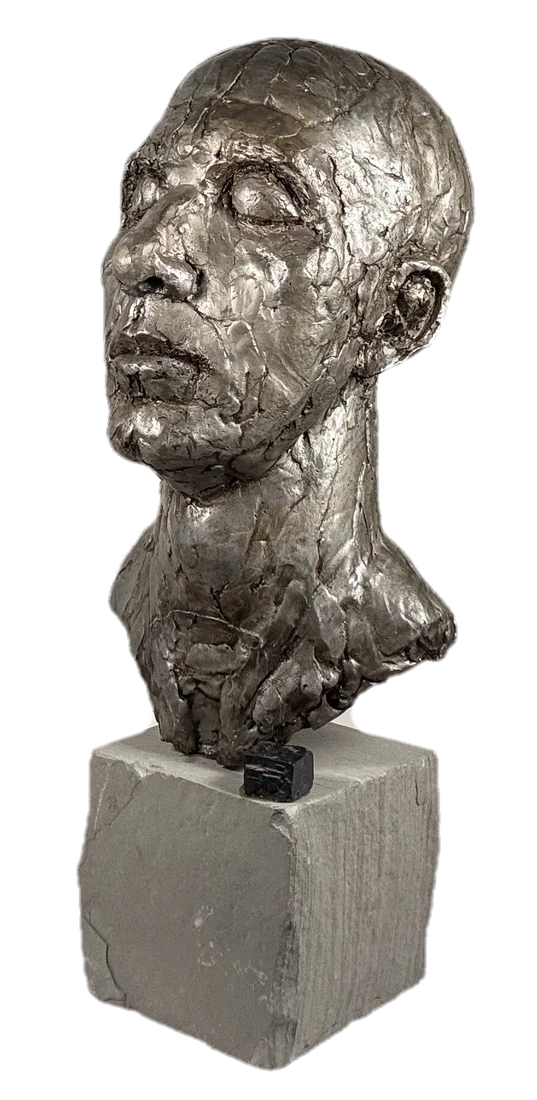
Chris #3 · Sara Paula Hoffman · plaster cast, metallic paint · 18 × 8 × 8 in · private collection · drag to turn
We chose one proportion and we keep it. That turns a thousand small guesses into a single decision, made once.
That is a kindness to the people who read the page and to the people who build it. The margin, the picture and the type all come from the same family, and anyone who works on the site can see why each size is what it is.
The things that matter most to reading don’t come from the golden ratio at all: letters large enough for your eyes, lines neither too long nor too short, and space between the lines that suits the size of the letters. Those come from measuring, and we measure them.
We still mean to ask people directly, by showing them two versions of the same page and asking which holds together better, and to publish what they tell us, whatever it is.
The rule is not there to replace the eye. Like the base under a sculpture, it gives the work steady footing, so the eye is free to do the rest.
The sculpture beside these words is Chris #3, by Sara Paula Hoffman, an artist we work with. I study art because artists are always turning the world around them into something the rest of us can share. This website, built on one rule taken from nature, is my try at doing the same.
Robert Duebelbeis, Good Citizens
Sources
Where the story comes from
Every claim above rests on one of these 10 sources. The small numbers in the text point here, and each source points back.
Book
Elements, Book VI, Definition 3David E. Joyce’s edition, Clark University
Reference
The golden ratioUniversity of St Andrews
Article
The golden ratio and aestheticsPlus Magazine
Peer-reviewed study
Misconceptions about the Golden Ratio·
The College Mathematics Journal
Article
Sea shell spiralsOn Clement Falbo’s nautilus measurements
Peer-reviewed study
Novel Fibonacci and non-Fibonacci structure in the sunflower·
Royal Society Open Science
Article
Quasicrystal discovery bags 2011 chemistry Nobel·
Peer-reviewed study
The so-called Fibonacci numbers in ancient and medieval India·
Historia Mathematica
Reference
Mark BarrReference
Canons of page construction