Case study · first edition · second edition · her words
Sales infrastructure
We turn how an art business already works into software that sells for it.
For one artist, that has meant two years of small, paid steps: off-the-shelf first, then a site built to do one thing, sell the work the way she and her galleries already sell it.
Where it stands: the site is built and selling. Two works have sold so far, each through a different gallery, a print at Buckham Gallery and an original at LeMieux; while a work hangs in a show, its page on her site sends buyers to that gallery. By October 2027 we’ll know whether the site sells more of her work than before.
- Client
- Sara Paula Hoffman (Paula), visual artist
- Site
- paulagallery.com
- Status
- Since December 2024 · built, and now measuring
One baseline · true relative scale · an inch is an inch on every row
- Act I, Seen But Not Heard · 2003 · Oil and mixed media on panel · 12 × 12 in
- Red Line · 2007 · Graphite and oil on Mylar · 24 × 36 in
- Chris #1 · Plaster cast, encaustic paint · 14 × 8 × 8 in
Second edition · October 16, 2026
Thirteen days later, a back office
The first edition ended with a site that sells. In the two weeks since, the site grew into Paula’s studio back office, with her catalog at the center and the rest reading from it.
She now answers our questions and approves what we write on a private studio page. Her catalog feeds a shop on Facebook and Instagram. A mailing list started from zero. A weekly post waits for her yes before it goes out. On October 10, the first collector registered the work they own. Not all of it is in use yet, and the list below says which.
Each of these is now something we can build for another artist, and Paula is our partner in doing that: for artists.
- July 2026The site rebuilt, every work at its true sizeOne catalog behind it, offers instead of a cart, and every old address kept.
- August 2026Prices worked out from her formulaPrice sheets for galleries from the same numbers, and a daily check on works in galleries.
- September 2026Records machines can readEach work described for search engines and AI assistants, and six portrait heads measured to turn.
- Early October 2026Her studio page, and the owner recordHer studio page, where she answers our questions. Collectors can register the work they own. A Monday email counts the week’s visits and lists the works people looked at most.
- Mid-October 2026Selling beyond the siteA Facebook and Instagram shop fed by the catalog, her own mailing list, and a weekly post she approves.
- NextShows, calls and deadlinesBuilt: every call with its fee, juror and works, and a reminder before each deadline. It starts when she enters her next one.
01 · Where it started
Her work was online, but not for sale
When we met Paula in late 2024, her work lived on a ready-made site for artists under her full name. It was a shop window with nothing priced and no door: no piece carried a title, a size or a price, there was no contact form, and no way to ask about buying one.
Her real inventory, the titles, sizes and prices, lived in spreadsheets on her own computer. The website showed the paintings but knew none of those details, so it couldn’t sell a single one. Her biography and exhibition record were scattered across a university page, Instagram, LinkedIn and several gallery listings, with no single official version for a search engine to trust.
02 · Do no harm first
A week at a time, off the shelf
Before building anything of our own, we got her work online, organized and for sale with tools that already existed, one paid week at a time.
Each week answered one question and was billed as one piece of work. We built her first real site on a Webflow template, tested it with Maze, watching real visitors use the site and asking them for feedback, and measured it with Google Tag Manager. We put her art on every channel we could: Facebook, Instagram, Google Business and the marketplaces of all three, each one leading back to one official record, the method we now call Canonical Presence. Free and off-the-shelf came first, the way you’d rent a tool before you buy one, and nothing custom until the cheap version had shown what it couldn’t do.
| Week | Trial | The question, or what it produced |
|---|---|---|
| Dec 3, 2024 | Creation and testing of art listing designs | How should one work be presented so a buyer can tell what it is, how big it is and whether it is for sale? |
| Dec 10, 2024 | Identification and connection strategy | Which channels does her work belong on, and how do they connect back to one place? |
| Dec 17, 2024 | Organization of collections and website | Her work, gathered into series and put online on a Webflow template, built that week. |
| Dec 24, 2024 | Planning gallery experiences and exhibitions | How her site should promote a show and send buyers to the gallery hosting it. |
| Feb 21–28, 2025 | Organization of inventory and pricing | Every work counted, sized and priced, in two weeks. |
| Mar 28, 2025 | Cross-country transport and handling | Getting work to and from galleries safely, in person. |
| May–Jun 2025 | Design and editorial support; securing development time | Keeping the site current while time for a custom build was set aside. |
The demo
Paula · Works by Sara Paula Hoffman
By February 2025 she had a site she could open and use: fifty works on their own pages, gathered into series, her exhibitions, a biography, and pages on purchasing, commissions and shipping. Her old address forwarded to it. Her two shows that spring, at Buckham Gallery, where a print sold, and at STLCC Wildwood, each had a page on the site from opening day, promoting the exhibition. Originals were available by inquiry, through a meeting booked with us as her representatives, and limited-edition signed prints sold through the site.
03 · The decision
What the off-the-shelf site couldn’t do
Paula sells through galleries. The off-the-shelf site could show her work, but it couldn’t sell it that way.
An original had no price a buyer could see or check, so every sale began as a meeting. A gallery’s price and her own couldn’t both be true on one page. And nothing kept the spreadsheet and the site in step: 32 of 33 available works came to have no retail price in the spreadsheet while the site quoted current ones. Those were the three things worth building for, and on July 31, 2026, the custom site went up.
Seven trials, one model of her business
Seven weekly trials, each a question answered and shown, taught us how her work is made, priced, shown and sold. Before any code, we wrote down what the trials taught as one model of her business, and held it to five things: anyone can check it, its rules always hold, it’s checked against the world every day, Paula edits it in three places, and it runs on as little as possible. That model was the first demo of the custom site.
Three moves, built from how she works
04 · The custom buildMove 1 · Jul 31 – Aug 1, 2026
One catalog that sells
The rebuild: every work in one catalog, at its real size, with an offer instead of a cart and the gallery getting the sale.
- 01
The work at its real size
Every piece is shown at its true size beside the others. One inch of artwork gets the same space on every row, so a twelve-inch panel looks small next to a thirty-six-inch drawing, the way it would on a wall, and each one casts the shadow its depth would cast when hung. The six portrait heads in Portrait Head Studies were photographed turning on a turntable, so you can drag to walk around them.
- 02
An offer, not a shopping cart
At these prices people don’t click “buy.” They make an offer, with the asking price already showing in the field. Every offer goes straight to the studio’s private desk, saved with the price that was on screen when it was made, and an email lets us know it has arrived. Over time that shows what people will pay for which pieces.
- 03
The gallery gets the sale
While a work hangs in a show, its page shows the gallery’s price and sends inquiries to the gallery instead of the studio, with a tagged link so the gallery can see where the visitor came from. When the show closes, the work goes back to its studio price. Galleries are how Paula sells, and the site is built to feed them rather than compete with them.
- 04
One catalog behind everything
Her whole inventory lives in one catalog. The web pages, the structured data search engines read, a plain-text edition for AI assistants, a written record of every work, the sitemap (the list of pages search engines are handed) and the sharing images all come from it, so they can’t drift apart. Every sharing image carries her seal, 宝拉, so work found elsewhere leads back to her.
Move 2 · Aug 2 – 6, 2026
Prices that keep themselves true
Every price worked out by the site from her own formula, and a gallery’s price kept apart from hers.
- 05
A price anyone can check
Paula prices by measurement: linear inches times her rate, plus materials, then a presentation share for framing, placement and stewardship, rounded up to the next hundred. Suspension is 24.5 linear inches at $125 with $40 in materials, so $3,102.50, times 1.35 for presentation, $4,188.38, published as $4,200. Each work page shows the price on one line and keeps the whole working one click below it, under “How this is priced,” so a buyer can follow every step. A work still waiting for its size or price says “On inquiry” rather than guessing.
- 06
The show price, kept apart
Her first show on the new site opened the day after the rebuild: LeMieux Galleries in New Orleans, from August 1. The gallery listed three of her works at 40 to 53% under her studio price. Those are the gallery’s prices, not a discount, so the next morning a show price became a record of its own, with its gallery and its dates, beside the work’s own price and never written over it. When the show closed, one change took the show prices away and her studio prices were back, untouched. We made that change twenty days after the close, which was longer than it should have been, and it’s why the daily check now flags a show that has ended with its prices still up.
Move 3 · Sep – Oct 2026
The studio, the schedule and the record
Heads you can walk around, a schedule that reads its own dates, her own desk, and a record of who owns what.
- 07
A schedule that keeps itself honest
Every show, open call and consignment is one record with its dates, and whether it reads upcoming, on view or past follows from those dates. Every morning a small job reads the gallery’s listing for each work still out on consignment (left with a gallery to sell for her) and notices if it has sold, gone on hold, changed price or can no longer be read. It reads the schedule too: a jury result that is overdue, a drop-off coming up, a show that closed with work still out, a consignment or online listing that has ended. Letters to her exhibitions address are collected automatically and likely acceptances are flagged; a person still reads each letter and drafts the listing from it. When something needs deciding it sends an email prompt. It never changes a price on its own, because why two numbers disagree is a question about a relationship, and a person should answer it.
- 08
Recent work first
The home page opens on Recent work: her newest pieces, each with its size, before any series. A new work does not have to belong to a series to be shown, so a piece can go online the week it is finished.
- 09
A rate she can try
A private page lets Paula try a rate per inch and a gallery’s commission and see a whole series repriced at once: the studio price, the gallery price, and what she keeps from each. It prices a new work from its size and prints the price list she sends a gallery. It reads the same formula the site uses, and changes nothing.
- 10
A record of who owns what
Anyone who owns one of her works can enter it on the work’s own record: when it came to them, and whether they may be asked to lend it to a show. They get its history back, title, size, series and every exhibition, with their ownership dated. The list is hers, written into her agreement with us, and used only to keep the record: the first word goes to an owner when their work is asked for. The first entry has come in: Thank You, Paid, the painting that sold through LeMieux, entered by the people who now own it. They asked to be credited as Private collection, New Orleans, LA, and said they may be asked about a loan.
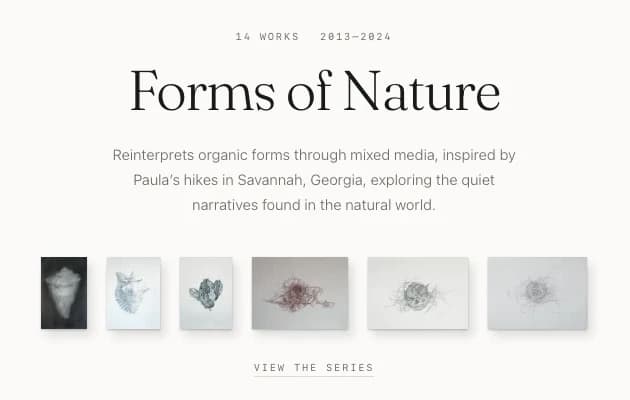
- The series, counted and dated: 14 works, 2013 to 2024.
- Every work at its true size beside the others. An inch of artwork gets the same space on every row.
- One link opens the whole series.
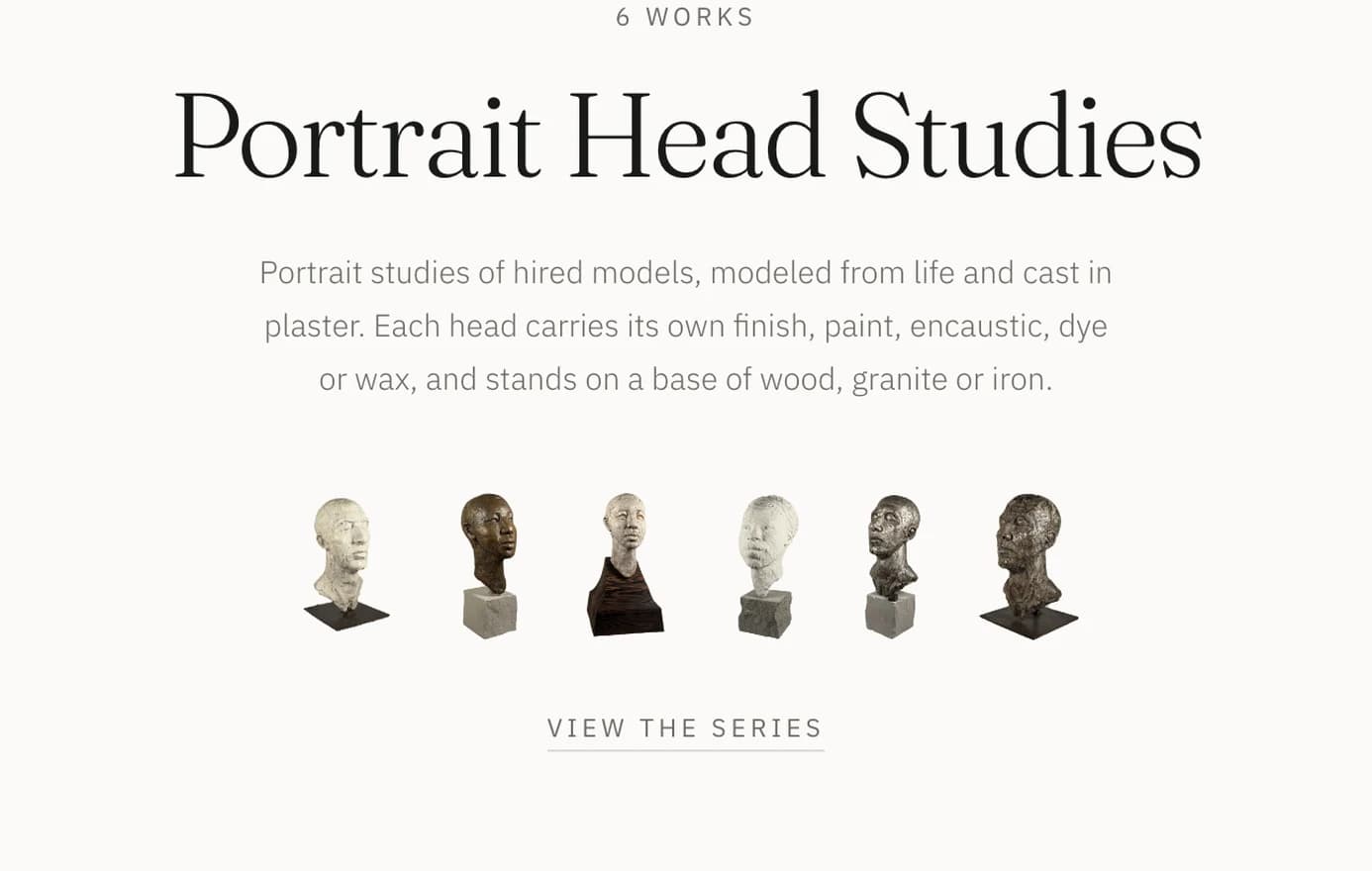
- In her words: portrait studies of hired models, modeled from life and cast in plaster.
- Six heads, each with its own finish and its own base. Each was photographed turning, so you can drag to walk around it.
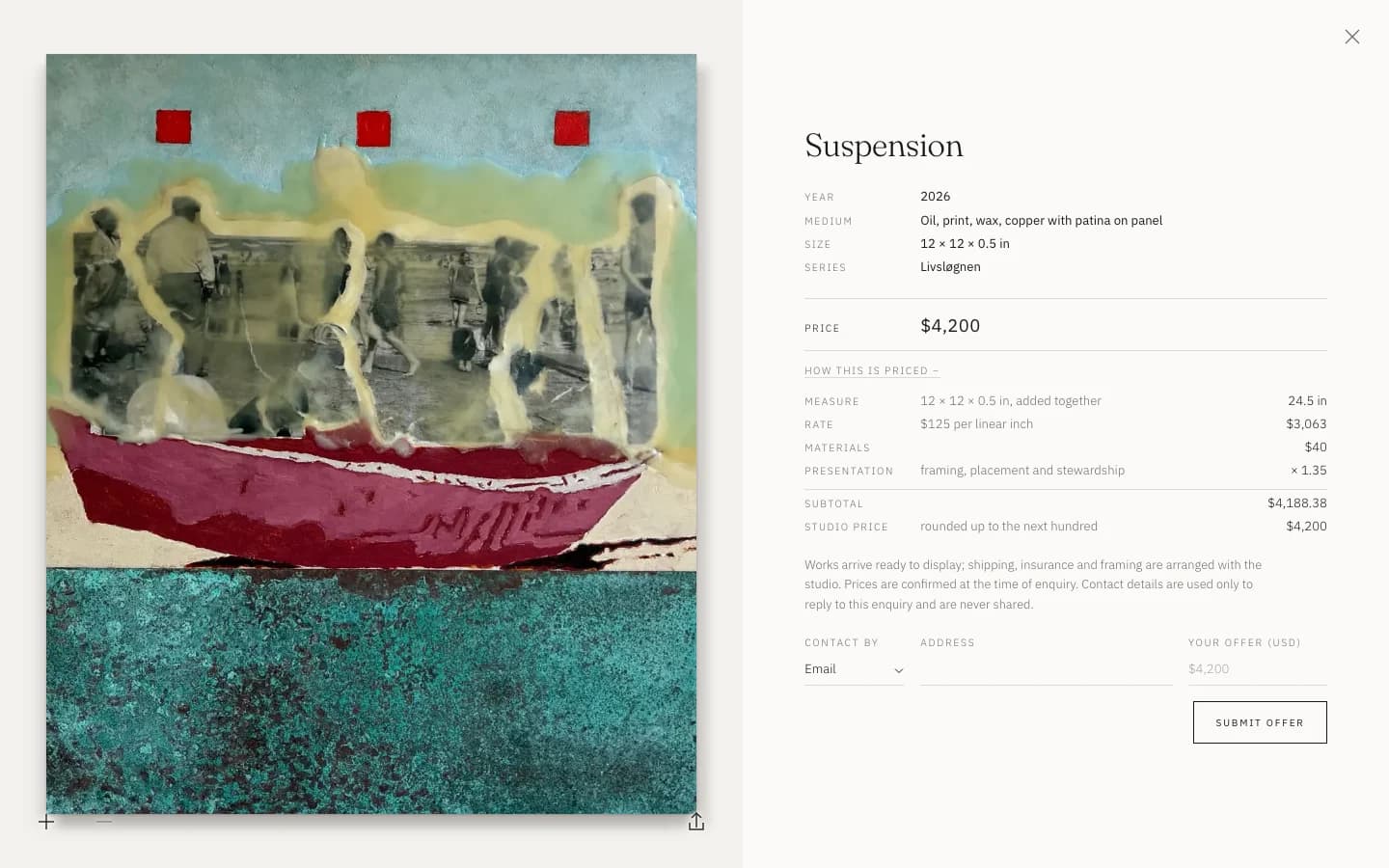
- The price on one line: $4,200.
- The working, opened: 12 × 12 × 0.5 inches, or 24.5 linear inches, at $125 an inch, $40 in materials, times 1.35 for presentation.
- The subtotal, $4,188.38, rounded up to the next hundred. Nothing says “price on request.”
- The offer form opens with the asking price already in the field.
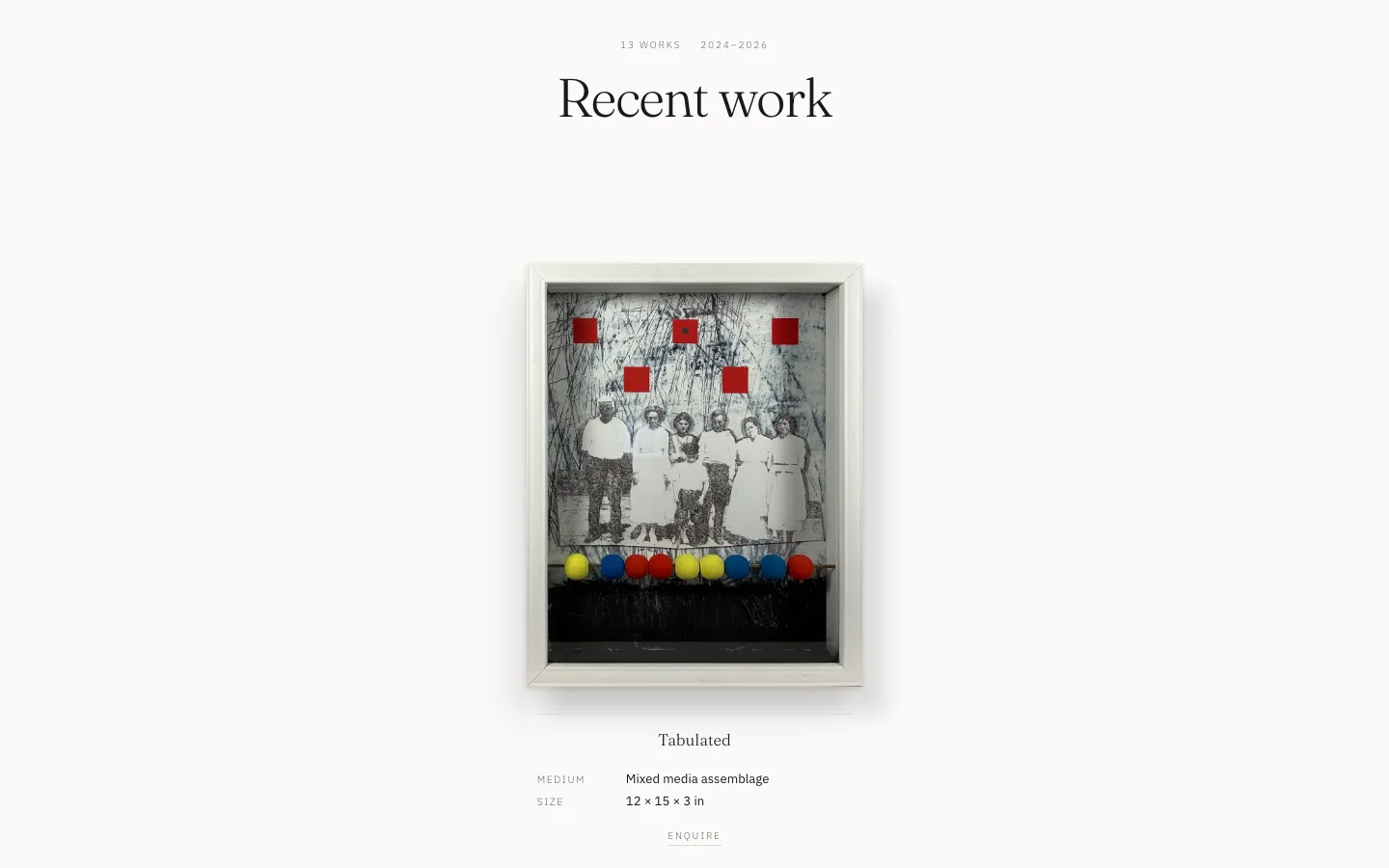
- Thirteen works from 2024 to 2026 open the site, before any series.
- Each with its medium and size, whether or not it belongs to a series yet.
- One link to inquire.
From the newest work to an offer
On a phone · 39 sThe same site on a phone: from the newest work to a price, an offer, and the surface of the painting.
Recorded on paulagallery.com in Safari on an iPhone, October 2026
05 · Filmed at home
Heads you can walk around
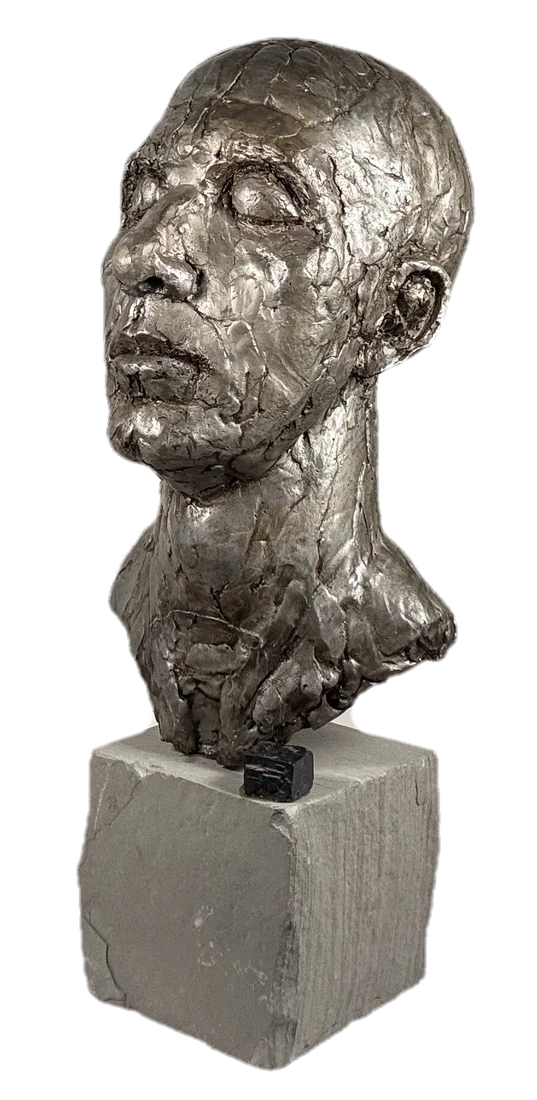
All six portrait heads now turn on the site, in a room of their own, Portrait Head Studies, the title Paula gave it.
Paula filmed each one at home. A kitchen lazy susan, a plain backdrop curved up behind it, even light, and a phone held still at the head’s own eye level about three feet away, with focus and exposure locked so nothing shifts as it turns. One slow turn takes about thirty seconds, filmed twice in case a hand gets in the way. We pull 23 to 26 frames from each take, even out the light, cut the head from its backdrop, and let every turn come to rest on a chosen frame, so the six read as one composition rather than six turntables.
06 · What runs by itself
Three things from Paula, and the rest follows
Paula looks after three things: the original photographs, a record of what each work is, and a record of what it costs.
Everything else is printed from them: the gallery images and the turns, the pages, a price worked out each time someone opens a page, a dated price sheet for her galleries, an inventory workbook written back to her own folder, the sharing images, and a record of every work for search engines and AI assistants. The pricing formula is written down in one place, and the site and every program behind it use that same one.
It used to be the other way around. The spreadsheet was the master copy and kept its own worked-out columns, which were filled in once and never again: 32 of 33 available works had an empty retail price while the site was quoting current ones. Now the spreadsheet is a printout of the record. Each printing makes a new dated file, so nothing she has is ever written over.
That’s the model we wrote down before any code, still standing. Each of the five things it was held to is something on her site you can check.
| No. | Held to | On her site |
|---|---|---|
| 1 | Anyone can check it | Every price shows how it was reached, one click below it, and every work is one record that the site, search engines and AI assistants all read. |
| 2 | The rules always hold | Her pricing formula is written down once, and the site and every program behind it use that same one. A gallery’s price is kept apart from hers. |
| 3 | Checked every day | Every morning a small job reads each gallery’s listing and the schedule, and sends a prompt when something needs deciding. It never changes a price on its own. |
| 4 | Three places to edit | Paula looks after three things: the photographs, a record of each work, and a record of what it costs. Everything else is printed from them. |
| 5 | As little as possible to run | The catalog is plain files and one build, with no database behind the works, prices or shows. The only database keeps what visitors send: offers, inquiries, ownership records and visits. |
07 · When something goes wrong
What happens when a work is damaged?
Anyone who ships things for a living knows that sinking feeling. Two assemblages, Manus and Dolls, An Adaptation, were damaged in shipping.
One change to the catalog took both off sale. Nothing else in the archive moved: every other price, page and listing stayed exactly as it was. That’s the quiet benefit of one catalog. A setback asks for one careful edit, not a dozen hurried ones.
08 · What changed
Seven things her site does now
- 01The work at its real sizeEvery work online is shown at its true size beside the others, and the six portrait heads turn.
- 02A price anyone can checkEvery priced work shows its price and exactly how it was reached.
- 03An offer, not a shopping cartEvery offer is saved against the work and the price on screen.
- 04The gallery gets the saleWhile a work hangs in a gallery show, its page sends buyers to the gallery, and two works have sold through two different galleries.
- 05A schedule that keeps itself honestShows and consignments are tracked by date, with a daily prompt when one needs a decision.
- 06One catalog behind everythingThe website, search engines and AI assistants all read from one catalog.
- 07A rate she can tryPaula can try a new rate and print a gallery price list without touching the site.
- Engaged since
- Dec 2024
- weekly trials, then a custom build
- Status
- Live
- two works sold, through two galleries
- Prices shown
- All
- every priced work carries its working
- Gallery sales
- 2
- a print · Buckham Gallery, 2025 · Thank You, Paid · LeMieux, 2026
- In the owners’ record
- 1
- entered by its owners, unasked
- Sales lift
- Pending
- being measured; the bar is set below
09 · What we don’t know yet
Does it sell more of her art?
Two works have sold, each through a different gallery: a print at her first show, at Buckham Gallery in spring 2025, and Thank You, Paid at LeMieux, in the show that closed on September 12. Two sales are a good start, not a result. The site records every offer, the steps people take on the way to one, and how long each work holds the people looking at it, and both of us get those numbers every Monday.
My husband surprised me with “Thank You, Paid” for my birthday! Or that was his excuse to buy it. We love it!!
We didn’t write down in advance what would count as working, and we should have. We’re writing it down now, dated October 2026: over the next twelve months, offers and gallery inquiries arriving through the site, against none that could arrive before it. If a year passes with no offer, the site isn’t selling, and we’ll say so here.
Those numbers get published here when there are enough of them to mean something, including the ones that go against us.
10 · What comes next
What comes after a site that sells?
Built with
- SvelteKit 2
- Svelte 5
- sharp
- Playwright
- Python + NumPy
- Neon Postgres
- Resend
- Vercel Cron
- Vercel
The building is done, and now we’re watching what people do with the site.
Her website finally works the way she sells, through galleries, so the next questions are about reach: how more people come to see the work. We haven’t tried advertising yet; working out how comes first. And we’ve begun writing down her brand identity, the first step toward taking her work to market under a name and a look that are unmistakably hers. Each of those starts the way the site did: one week, one question, a date.
11 · In her words
What it has been like for her
We asked Paula five questions on her studio page: how she found us, when it first worked, what felt slow or expensive, whether the site feels hers, and how she’d describe us to another artist. This is her answer, whole, as she wrote it on October 22, 2026.
I feel the site and records are mine.

I was aware of Good Citizens’ web development for a non-profit group and later work building a landscaping tool from city data. Web design and graphic design elements were high quality; these aspects immediately elevated my website. As my digital studio was developing, my work was catalogued and narrated. This process was quite helpful as a retrospective study and motivating in new work.
Initially costs felt expensive; however, my professional digital presence supported a recent sale to a collector in New Orleans.
I feel the site and records are mine and that I work closely with Good Citizens to bring my work to audiences in digital and physical spaces.
Good Citizens supports and promotes an artist’s goals and professional presentation. The digital studio is a collaboration; Good Citizens listens, supports and promotes in an ongoing dialogue with the artist. They share the digital studio activity, viewer’s interest and enquiries similar to a physical gallery space. Working with Good Citizens has been an insightful, rewarding, and motivating experience for me.
Digital representation
Does your work look worth its price?
Start where Paula did: a free first call, one question, and a week of work you can stop after.